
While I was in Ypres during April 2025, I was able to arrange a trip which I had wanted to take for some time. I had planned a road trip which would take in such iconic battlefields such as Agincourt and Crecy. (I will post details of these battles soon), an overnight stay in Rouen and finally to the destination, which is St Nazaire. Located on the Loire River Estuary and the Atlantic Ocean. St Nazaire is the location of what became known as “the greatest raid of all.” A mission which reads as a “Boys Own Epic”. Hollywood could not have derived a script so daring and courageous that anyone would believe actually happened.
When aged nine I became the custodian of a medal set to a Pte Francis Kelly. Francis is buried at Escoublc-La-Baule War Cemetery, a small peaceful English Garden located, among polite, well-kept holiday villas. Lying some 9 miles west of the harbour of St Nazaire.

Francis Kelly was born in Liverpool on the 18th June 1920 to Jospeh & Mary Kelly. In 1939, he worked as a brick layer. With the outbreak of war, he joined the Border Regiment, before answering the call for the Commandos. He joined No2 Commando, who had originally formed in June 1940. In November 1940 they had been renamed 11th Special Air Service and again renamed 1ST Parachute Battalion. Once this occurred a new No2 Commando was formed, which Francis joined.
The first action for the new No 2 Commando was Operation Archery where two troops supported No 3 Commando in the Vaagso Raid on the 27th December 1941. Francis was one of soldiers who took part with the two troops of No 2 Commando. The operation was more about a psychological hit and run attack, convincing the Nazis that they were prone to commando style attacks all over Norway. It was a tough baptism for No 2 Commando. The German resistance was stubborn, and the presence of Gebirgsjager (mountain Rangers) troops who were on leave from the eastern front added to the mix. It involved house to house fighting and the toll, taking the major strong point, the Ulvesund Hotel was costly with the loss of numerous officers.

In the end the commandos destroyed fuel depots, ammunition dumps, several military installations, a store of fish oil and a telephone exchange. They also captured 98 German POWs as well as some Norwegian Nazi collaborators called Quislings. The Commando’s lost 20 men and 53 wounded, while the Germans lost 120 not including the POWs. By the time of D-Day in June 1944, the Germans had over 400,000 troops in Norway, such was their worry of invasion, which in part were due to raids such as this.
St Nazaire is strategically positioned on the north bank of the Loire Estuary. During World War I it was an especially important de-embarkment port for British and Commonwealth Troops. Then in 1917, the United States used the port to bring their troops and logistics. The town was known for ship building, especially large passenger liners. They had built the SS Paris and SS Ile de France in the 1920s. Due to the Great Depression, the state commissioned a state-owned shipping company to build a new exceptionally large luxury liner. They commissioned Albert Caquot, to construct the Loui Joubert dry dock. Albert was a World War One hero and post war one of the major engineers in the world. He created the internal structure of Christ the Redeemer, located in Rio de Janeiro in 1931.
The dry dock at St Nazaire was needed to build the SS Normandie. The dock measured 350m x 60m and was the largest dry dock in the world when finished in 1933. The SS Normandie was launched in 1935. It was the largest and fastest passenger liner at that time.


With the fall of France in June 1940, the Kriegsmarine (German Navy) took control of the port and set about constructing one of their Atlantic facing U-boat pens. U-46 arrived in the port as soon as September 1940. It was constructed by Organisation Todt which started work in February 1941 and the first pens which were usable, were unveiled by Karl Donitz in June 1941. U-203 was the first submarine to occupy one of the pens.

In 1938 the Germany Navy laid down a master plan to create a military Navy which would match the Royal Navy, yet ships take much longer to plan and construct, while planes and tanks can be produced relatively quickly. At the time the war broke out they only had two large battleships in construction. The Bismarck and the Tirpitz. The Royal Navy was genuinely concerned about these two ships and the flotillas which would escort them. The German Navy would use the Baltic in relative safety, yet they needed to find a route to the Atlantic, to wreak havoc on the allied convoys. This would be done, by leaving the Baltic, heading to Norway for supply and then via the North Sea and Iceland or Faroe Islands to enter the Atlantic.

The Bismarck was the first to be constructed and was the first to find its route to the Atlantic. It was such a concern to the Royal Navy that they diverted needed vessels to hunt down this new mega battleship. Leaving Bergen in Norway, the Bismarck sailed with the cruiser Prinz Eugen, north of Iceland before heading south into the Atlantic. The Royal Navy detached ship after ship to intercept and sink the Bismarck. HMS hood was sunk, and HMS Price of Wales was severely damaged. In May 1941, the chase was on to stop the Bismarck causing death and destruction in the Atlantic. It was noted that the Bismarck turned east towards St Nazaire, for repairs., yet the aircraft carriers HMS Victorius and HMS Ark Royal dispatched their Swordfish Torpedo biplanes to deliver the death nail to the Bismarck on the 24th and 26th May 1941. On the 27th May, the heavy cruiser HMS Dorsetshire fired three torpedoes into the stricken Bismarck, and it sank.

The Royal Navy took notice that St Nazaire was the only port outside of Germany with a dry dock big enough to take a ship of this size. Thus, Churchill instructed plans to be drawn up for the dry dock to be destroyed so that the sister ship, the Tirpitz, could not have a repair facility on the Atlantic. The port was heavily defended, and an air attack would be very costly due to the anti-aircraft protection, added to the strength of the construction. The brief was handed to Lord Mountbatten, chief of Combined Operations to devise a plan. The word Combined is a loose term. In 1941/42, Mountbatten had an excellent Army Commando complement, yet the Navy and Royal Air Force had other priorities. The Raid on St Nazaire, or Operation Chariot as it would be known would have to be planned and devised without the best Naval vessels and less than a full commitment from Bomber Command, who were busy across the rest of Europe and Germany. One hundred bombers were requested by Lord Mountbatten for the diversionary attack from the air, yet only thirty five were granted. Yet we cannot forget the constant reconnaissance missions flown before and after the mission.
The plan was to sail to St Nazaire, destroy the dry dock and other port facilities and then escape back out to sea. The negatives to this plan, were as follows. It was one of the most defended ports in France and the deep-water channel was heavily defended from both sides of the Loire River Estuary. Also, if you managed to land troops how to do you destroy one the largest dry docks in the world. The lock doors weighed 1,500 tons when flooded. Finally, after landing and setting the town ablaze, how do you escape from a town which is garrisoning 5,000 German soldiers and sailors.

The operation was handed to No 2 Commando, yet small specialist elements of other commando units were utilised. There were elements of No, 1,3, 4, 5, 9, 12 Commando. The plan was devised with seventeen small motorboats consisting of fifteen Fairmile B motor launches, one Motor Torpedo Boat and one Motor Gun Boat. At the centre of this flotilla was the World War One Town Class Destroyer, HMS Campbeltown, which originally was the US Navy USS Buchanan.


The boats would carry 341 sailors and 271 commandos. They would have to bring and carry everything the needed to complete the mission. The key target was the dry dock, which was to be rammed by HMS Campbeltown, who concealed a secret. Built into a concrete steel plated chamber deep within the Campbeltown were 24 depth charges all fused and connected to delayed detonators. The explosive was to destroy the entrance to the dry dock and put it out of action, thus denying the Tirpitz a repair harbour on the Atlantic coast of France.
Other targets around the harbour would be attacked, so commandos would disembark from the small boats and Campbeltown to wreak havoc on the German defences of St Nazaire. The final part of the plan was to launch the operation during the high spring tides which would exist for a couple of days at the end of March. This would allow the flotilla to avoid the deep-water channel, as this was more heavily protected. They would travel over the sand and shingle bars, which the Germans would not have expected and allow them to get as close to the target as possible before being discovered. The Campbeltown was also disguised as a German destroyer, again to buy time and get as close as possible.
Pte Francis Kelly was aboard the MGB314. This was the most powerfully armed small boats taking part in the raid. It was designated as the Headquarters Ship with both Force Commanders on board, along with their Headquarters Parties and a small Intelligence element. Having recently operated as part of Commander Ted Davis’ ‘Special Operations’ flotilla, based onDartmouth, her captain and crew were also much more experienced than was the general case with the Fairmile launches.

So, on the 26th March 1942 at 1pm, the flotilla set sail from Falmouth to cover the 420-mile route to St Nazaire. It began with 18 small boats, but one had to return due to engine trouble. The flotilla was spotted by U-boat U-593, but they misreported that the flotilla was sailing away and was just a mine sweeping operation. By 10pm on the 27th March, they were just 40 miles from the dry dock.
At 12:35am on the 28th March, the flotilla was now only 11 miles from the dry dock and still undiscovered.
At 12:45am the Campbeltown ran aground on the shoal bank twice yet managed to continue.
At 1am, they were spotted by a German patrol boat, which had no radio. They were also spotted by a commander of a Flak Battalion, but he was not believed.
At 1:20am the Germans now felt this is an enemy attack and orders are issued to repel the assault.
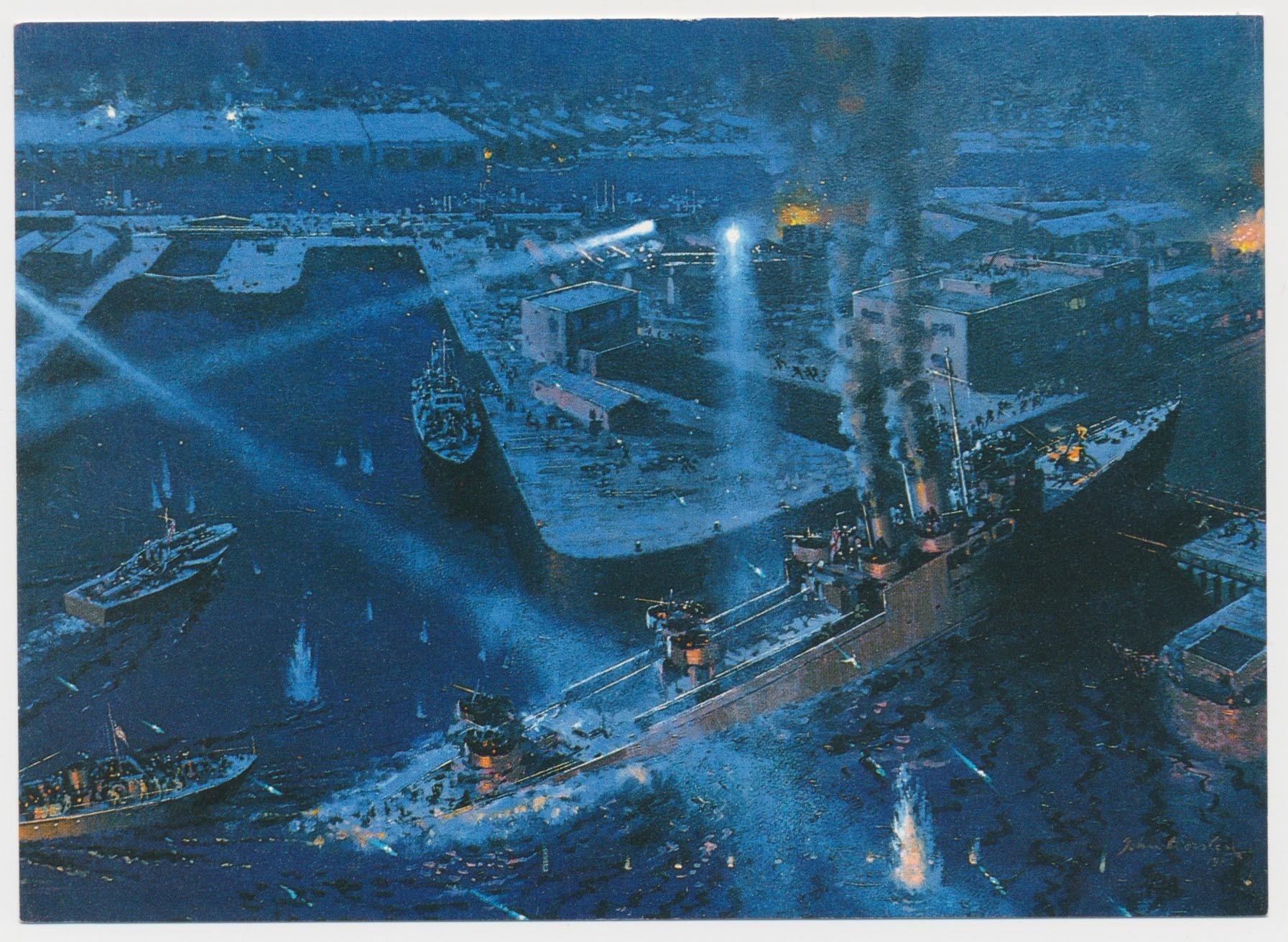
At 1:23am all hell breaks loose. The German Ensign is lowered on the Campbeltown, and the White Ensign is hoisted. The flotilla is remarkably close to the dry dock, yet they are also very close to the enemy firing positions. They are now within the harbour approach.
MGB314 which Pte Kelly is aboard, is first into the harbour and attacks the German protection ship Sperrbrecher 137, located just off the East Jetty. With the aid of following launches, the German ship is soon ablaze.
At 1:28am ML156 takes a direct hit in the bridge wounding numerous Navy and Commando officers. ML446 is also hit killing Captain Hodgson who was the leader of the Commando Assault Party. Campbeltown is being repeatedly hit. Lt Commander Beattie is distracted by shells, smoke and searchlights and notices they are heading to the wrong light house. He corrects the ships position quickly and brings the ship back on track for the dry dock.
He clears the mole with the correct lighthouse and swings Campbeltown round by 350 degrees heading directly at the dry dock gate. Speed is now 20 knots, and he pushed through the protective torpedo net and smacks straight in the dry dock caisson dead centre. The speed ensures she climbs up over the and onto the wide lock gate. It is now 1:34am, and he is just 4 minutes late from the timings laid down in the operation plan.

The small boats, made from wood and petrol powered had no protection as many burst into flames. The landing points for the small boats were under constant enemy fire. Boats were ablaze and creating obstructions for others arriving. Due to the skilful leadership of Lieutenant Commander Stephen Beattie, he was able to ram HMS Campbeltown directly into the front lock gates of the dry dock. He was under constant enemy fire, yet he managed to put Campbeltown exactly where he wanted. He was also able to get his 78 commandos onto the dockside as well as evacuate his naval personnel.

Now with the commandos on dry land they set about their business. The demolition troops located their objectives, set charges, and blew them sky high. They blew the important pumping station and two winding houses, which were used to open and close the dock gates. All other targets were also dispatched. Their training in the docks of Cardiff and Southampton had paid off. All they now needed was the explosive on the Campbeltown to erupt and destroy the dry dock.
It also now dawned on the commandos and their commander Lt Col Charles Newman, that their retreat may not by that easy, as most of the small boats they arrived in were ablaze in the estuary. As with all commandos, there was no thought of surrender, the plan was now to fight their way out of the tightly controlled perimeter and in small groups, make for Spain and Gibraltar. (it is 400 miles to the Spanish border) The exit from the harbour was via a small lifting bridge which the Germans had protected. The commandos charged the bridge with the small amount of ammunition they had left. Some only had their FS knives as they had run out of bullets. The Germans with far superior numbers started to pick up small groups of commandos who were either out of ammunition, wounded or totally exhausted. For these men, they would be prisoners of war until the end of war. Five commandos did manage to get to Spain and back to England, with the assistance of the French Resistance.

Yet while the captured commandos were being questioned and documented as prisoners. Their thoughts turned to Campbeltown which had not exploded. Was the mission a failure? Then at 10:30am on the 28th March they witnessed a huge explosion which ripped through the Campbeltown and sent steel and concrete flying in all directions. It ripped open the dry dock caissons. The damage was so extensive that the dry dock was put out of action for the rest of the war.
At this time, the Germans were exploring the depths of the Campbeltown. There was around 40 German Officers on the ship. They were swarming all over the vessel and dock area. The explosion killed everyone on the Campbeltown as well those close by on the dock, which included some French dock workers. The Campbeltown death toll was around 360.

There was a great debate why the depth charges on Campbeltown took so long to explode. The answer may be in the fact that two types of fuse had been tested. One was a two- and half-hour time pencil and the other was an eight and half hour acetone-cellulose delay. When tested it was found the pencil worked like clockwork, while the acetone-cellulose delay was prone to firing two hours late. Both were also to be set differently. The pencil was activated remotely from a concealed compartment in a wardroom leg. The Acetone delay had to be embedded in the charges with no future intervention. The worry was an incoming shell may damage the wardroom and thus the device to set the pencils. Therefore, it was decided to set the Acetone delay before the Campbeltown entered the river Loire. This would have been at 11:30pm British time. They fired the charge and the explosion at 10:30am British time, some eleven hours later, so around half an hour longer than the tests carried out back in England.
It was a costly success. Out of the Naval and Commando combined force 169 were killed and 215 became prisoners of war. Only 4 of the small boats were able to return to England. Most of the retuned were those who had not been able to land or were commanding the surviving small boats.


The Tirpitz never left the fiords of Norway and was eventually sunk in November 1944 by British Lancaster bombers.
Pte Francis Kelly disembarked from MGB314 with the Head Quarter sections. Both commanding officers were now on dry land, as they wished to direct the action from within the harbour. Both Commander Robert Ryder, the Naval Force Commander and Lt Col Augustus Newman, the Military Force Commander were awarded the Victoria Cross for their actions. Newman was captured and became a prisoner of war. Ryder managed to get MGB314 back out of the estuary where he transferred to another ship before the severely damaged MGB314 was scuttled. The only confirmation I have for Pte Kelly is that he was initially reported missing and then confirmed killed in action. I do not have the exact nature of his movements yet hope by continued research I may be able to shine some light on his last moments.
When you visit St Nazaire, the dry dock is still there and the main points of interest for the commando attack are laid out with information boards. The area is very contained, and the mole still exists. The lifting bridge is still in place, where the final charge of the commando took place. The starting point for anyone visiting the battlefield is the Commando Memorial near the original Mole. The memorial lists the names of all who fell in the early hours of the 28th March 1942. From here you can walk a pre-determined route around the battlefield with seven individual information boards at certain locations. You get the feel for how confined this space was back in 1942.


The U-Boat complex also exists and is worth a visit. To get the scale and enormity of such a structure you must walk within the cavernous pens. The town has a post war French submarine which is housed in the huge gate block pen, which was the entrance and exit to the pens. You can explore the submarine which is very well presented.

Travelling west you will come to Escoublac-La-Baule Cemetery. This cemetery began with the burial of 17 British soldiers killed in the area during 1940, 21 others who died in local hospitals, and a number of British servicemen whose bodies were washed ashore after the sinking of the troopship “Lancastria” in the Bay of Biscay on 17 June 1940. Subsequent burials include men killed in the St. Nazaire raid in 1942, and airmen shot down in the area. The cemetery now contains 325 Commonwealth burials of the Second World War, 74 of which are unidentified.

This is where Pte Francis Kelly was laid to rest and finally, I was able to bring his medals to his grave. It was very emotional for me. I have been the custodian of his medals since a young age and had always promised him that I would make this trip. Finally, I had kept this promise.


On the 1st April 1942, the German command held a joint burial service at Escoublac. The remaining prisoners of war were able to bury their fallen comrades with full military honours provided by the German soldiers.


Also of note is Louise Jaouen who was a local from la Baule. During German occupation, she maintained the graves within the cemetery. She collected funds from local people and laid a small monument at each grave, planted hedges, and employed a full-time gardener to tend the cemetery. Louise was awarded the King’s Medal for Services in the Cause of Freedom.
You can also visit some of the batteries on both sides of the estuary. I visited Fort de I’Eve which is located 5 miles west of St Nazair harbour. It was originally a French fort built into the cliff with underground barracks. The site started in 1859 and was expanded in 1890. Much of the original fort exists. After German occupation, the Kriegsmarine took over the fort and removed the older French guns. They installed four 7.5cm guns, four 17cm guns, a 5cm Pak gun and three 2cm Flak Oerlikon guns. Its position was protecting the north coastline of the Loire River Estuary.

The only action that MKB Bencke, which the fort was then called by the Germans was on the night of the St Nazaire raid. Due to it position west of the harbour, the British flotilla had passed them by before they were discovered. Yet on the return, back out to sea, the guns of the fort sent shell after shell at the escaping small boats.


I also visited Le Grande Blockhaus which is located near Batz sur Mer. This is a very well preserved five level observation blockhouse. It was built as part of the Atlantic Wall and construction started after the St Nazaire raid. It has an excellent museum and is worth a visit. One of its artifacts is a door from the Campbeltown, which was retrieved from the seabed. The reason it existed, was to direct fire from two huge railway guns which were located around a mile inland.


I was so glad to have made the long journey from Ypres. I have walked some historic Medieval battlefields on my way, which I will post about over the coming week or so. They too are worth a visit and so close to the channel ports. Rouen and St Sever Cemetery were also wonderful places to visit, but my journeys end, the industrial port of St Nazaire was a pilgrimage which had to be done. I am so glad to have reunited Francis with his medals and in some small way to tell his and his comrade’s story. It was truly the Greatest Raid of All.
I will finish with a transcript from Forgotten Voices, a book consisting of the audio archives held by the Imperial War Museum in which the following was stated…
Just before the Campbeltown exploded, Sam Beattie was being interrogated by a German naval officer who was saying that it wouldn’t take very long to repair the damage the Campbeltown has caused. Just at that moment, she went up. Beattie smiled at the officer and said, ‘We’re not quite as foolish as you think!